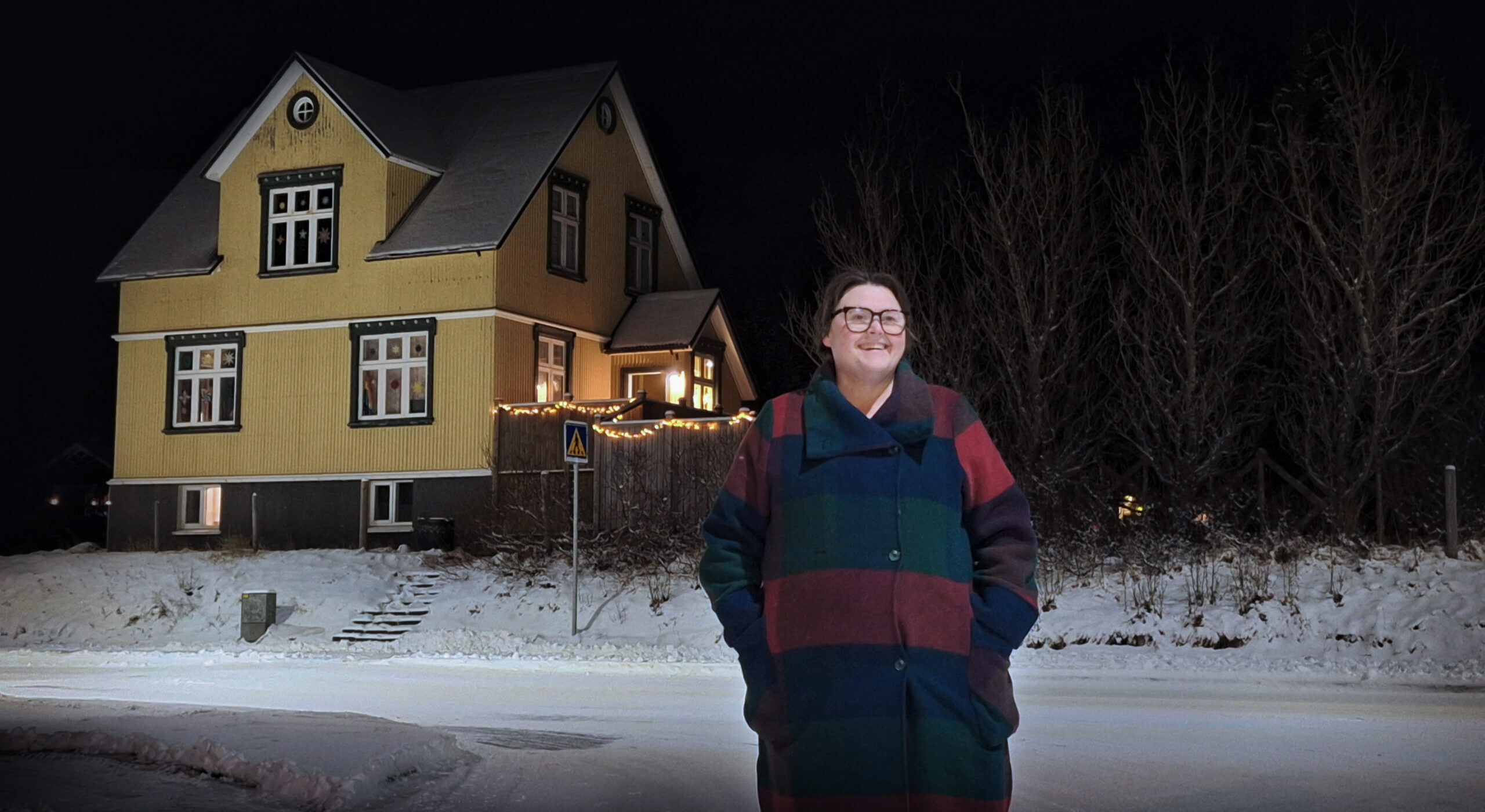
When Nicola van Kuilenburg moved to Húsavík a few years ago, it was not part of a long-held plan. Like many others, she first encountered the town through cinema, through the film Eurovision Song Contest: The Story of Fire Saga, that she watched repeatedly during the long months of the Covid pandemic. At the time, Nicola was living near Washington DC while her wife was based in Reykjavík, and watching the film became a small ritual of connection across the distance. When they finally travelled north together, Húsavík quickly became something more than a movie location.
Today, Nicola is a familiar figure in the cultural life of the town. Originally from England, with years spent living in the Netherlands and the United States, she has lived in Húsavík since 2021 and works at the Húsavík Museum & Library, while studying folklore and museum studies at the University of Iceland. Over the past few years, she hascreated exhibitions that give space to voices not always centred in local storytelling, young people of foreign origin, immigrants reflecting on their childhoods before moving to Iceland, and most recently, members of the Húsavík LGBTQ+ community.
Her newest project Nágrannar/Neighbours builds on that work. This time, the focus is not only on immigrants, but on relationships: the everyday connections between people of Icelandic and foreign backgrounds who live, work, or simply share life side by side in Húsavík and across Norðurþing. Supported by a grant from KEA, the exhibition will present four pairs of people, eight individuals in total, through interviews and photography, highlighting what they learn from each other, how they benefit from their relationships, and what those connections mean to them.
“We don’t always talk about the relationships”
Nicola speaks thoughtfully, often pausing to choose her words, especially when discussing community and belonging. For her, the idea for Neighbours came from noticing a gap, not a lack of diversity, but a lack of conversation about what that diversity actually looks like in daily life.
“In Húsavík, there are lots of people from different backgrounds,” she says. “But we don’t always talk very much about the relationships between people, how they work, or what they give us.”
Previous exhibitions had focused on specific groups, but this time she wanted to widen the frame. Instead of telling one side of the story, she wanted to bring people together, literally and narratively.
“I felt it was important to include Icelandic voices as well,” Nicola explains. “To show these relationships as something shared, not something separate.”
Four pairs, eight stories
The structure of the project is simple but deliberate. Nicola is looking for four pairs of people, an Icelandic person and a person of foreign origin, who already have a relationship. They might be neighbours, colleagues, or close friends.
She plans to interview each person separately, asking them about how they met, what they learn from one another, and how the relationship has shaped them. She will then photograph the pairs together, creating visual portraits that reflect connection rather than difference.
“I want this to be a positive exhibition,” she says. “Something uplifting and optimistic. How people benefit from relationships with someone who has a different background.”
Participants are asked for about an hour of their time. From that, Nicola will create a free exhibition hosted at the Húsavík Museum and the library. “I’m really proud that the museum and the library keep giving me room to do this work,” she says. “It means people can just walk in, read stories about their neighbours, and hopefully recognise something of themselves.”
Inclusion and unfinished work
As someone who both lives and works in the community, Nicola has a grounded view of how Húsavík and the municipality Norðurþing are doing when it comes to inclusion. She is careful not to paint too dark a picture, but equally careful not to idealise. “I think we’re going in the right direction. It’s good to see people of diverse backgrounds in many different roles around town.”
She points in particular to Norðurþing’s willingness to employ people who do not yet speak fluent Icelandic in positions beyond tourism or service work. When Nicola started working at the library nearly four years ago, this was still relatively unusual. “That kind of commitment really matters,” she says. “It changes what’s possible for people.”
At the same time, she feels that people still live “a bit too much side by side,” rather than truly together. There is no single solution, she says, but there are clear areas where improvement is needed. One of them is language education. Many immigrants, she notes, are eager to learn Icelandic, but struggle to find opportunities beyond beginner levels. “You can learn your numbers and your colours,” she says with a small smile, “but after that, it becomes very hard to move forward.”
She also speaks candidly about curiosity, or the lack of it. “I think Icelanders could be more curious about their foreign neighbours. That might not always be popular to hear, but I think it’s true.” Still, she remains optimistic. Projects like Neighbours, she hopes, can help open doors to conversations that don’t always happen on their own.
From a movie to a home
Nicola is well aware of the irony that a fictional film was the starting point for her life in Húsavík. But when asked why she is still here, her answer has nothing to do with cinema. “Húsavík has given me opportunities I probably wouldn’t have had elsewhere,” she says.
As a student of folklore and museum studies, she has been able to apply theory directly into practice, curating exhibitions, working with stories, and engaging with the community in tangible ways.
“I don’t think that would have been possible for me in Reykjavík,” she reflects. “Here, I’ve been trusted.” She says that trust has created a sense of responsibility as much as belonging. “I feel like I want to give something back to Húsavík because of that,” she says. “And this project, that’s part of how I try to do it.”
If you are interested in being interviewed for this project, you can find Nicola on Facebook or at the Húsavík library.